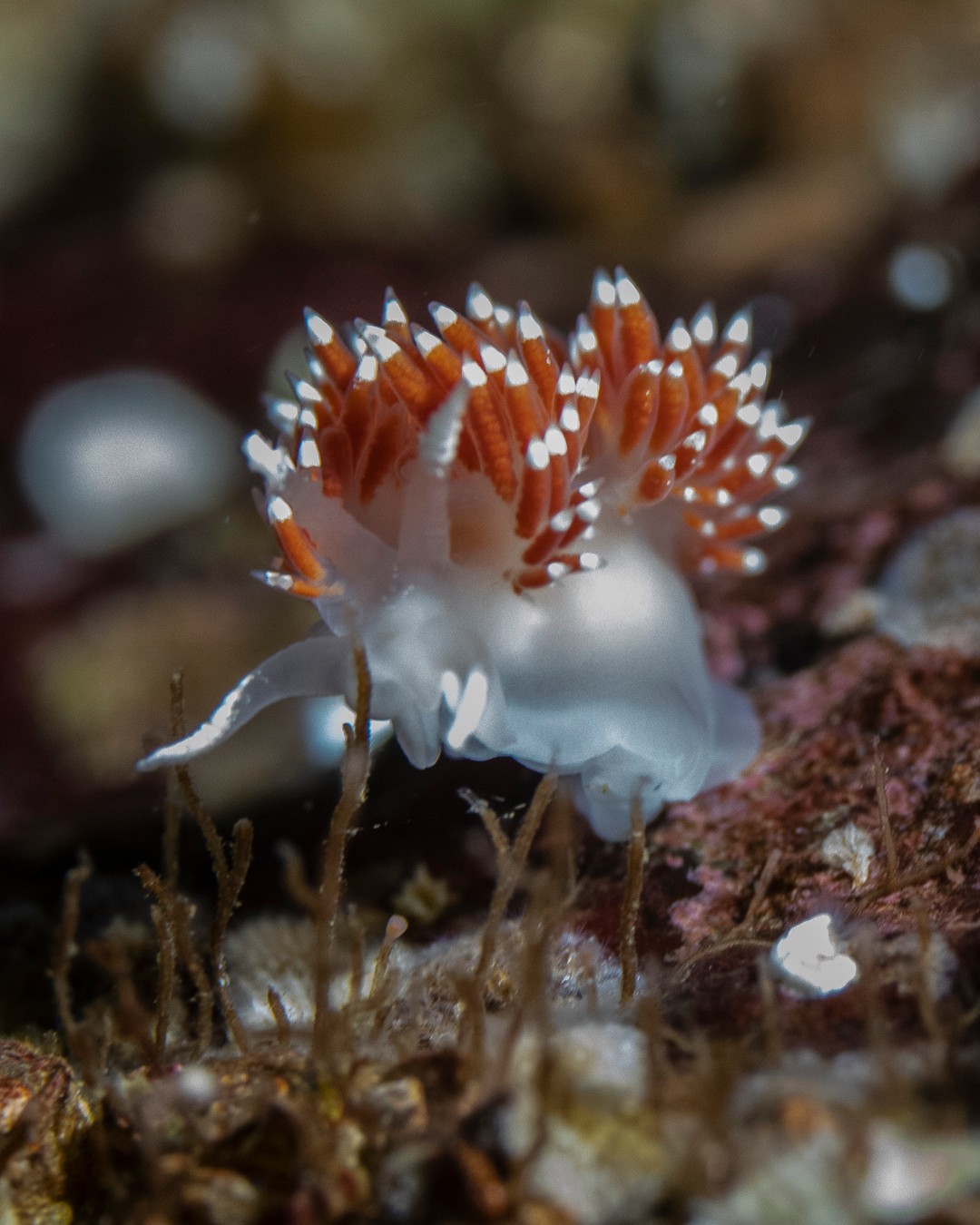
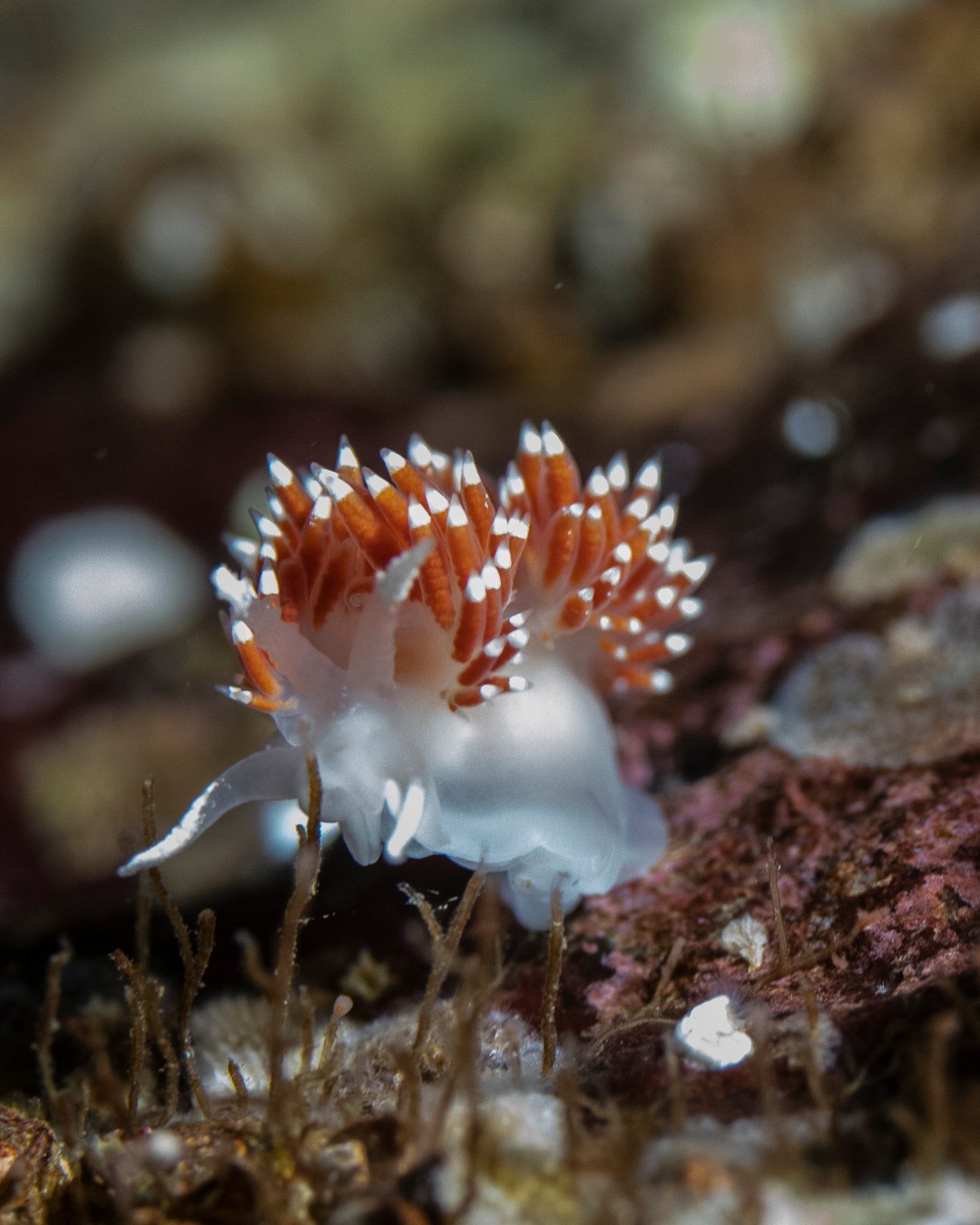
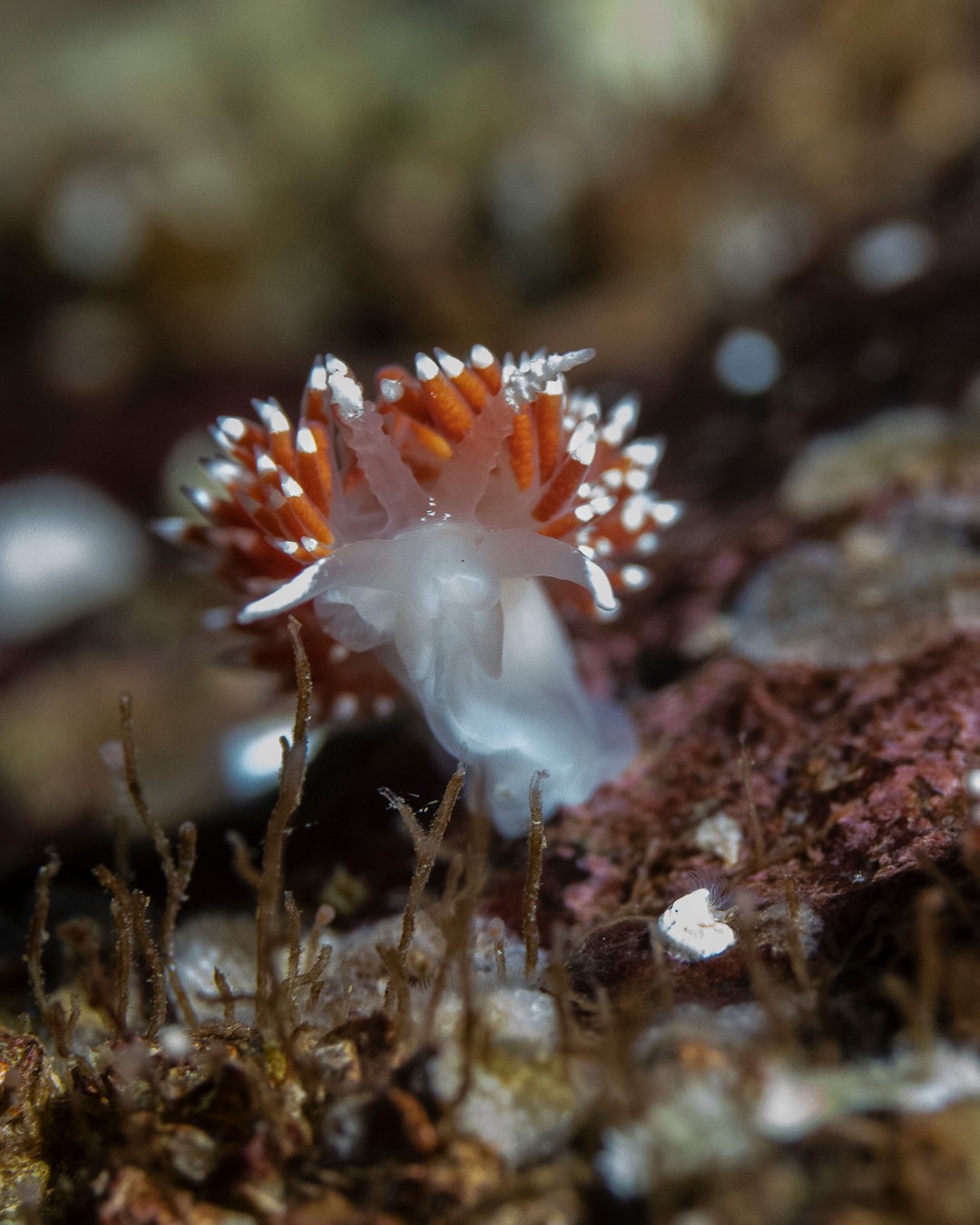
Flameback
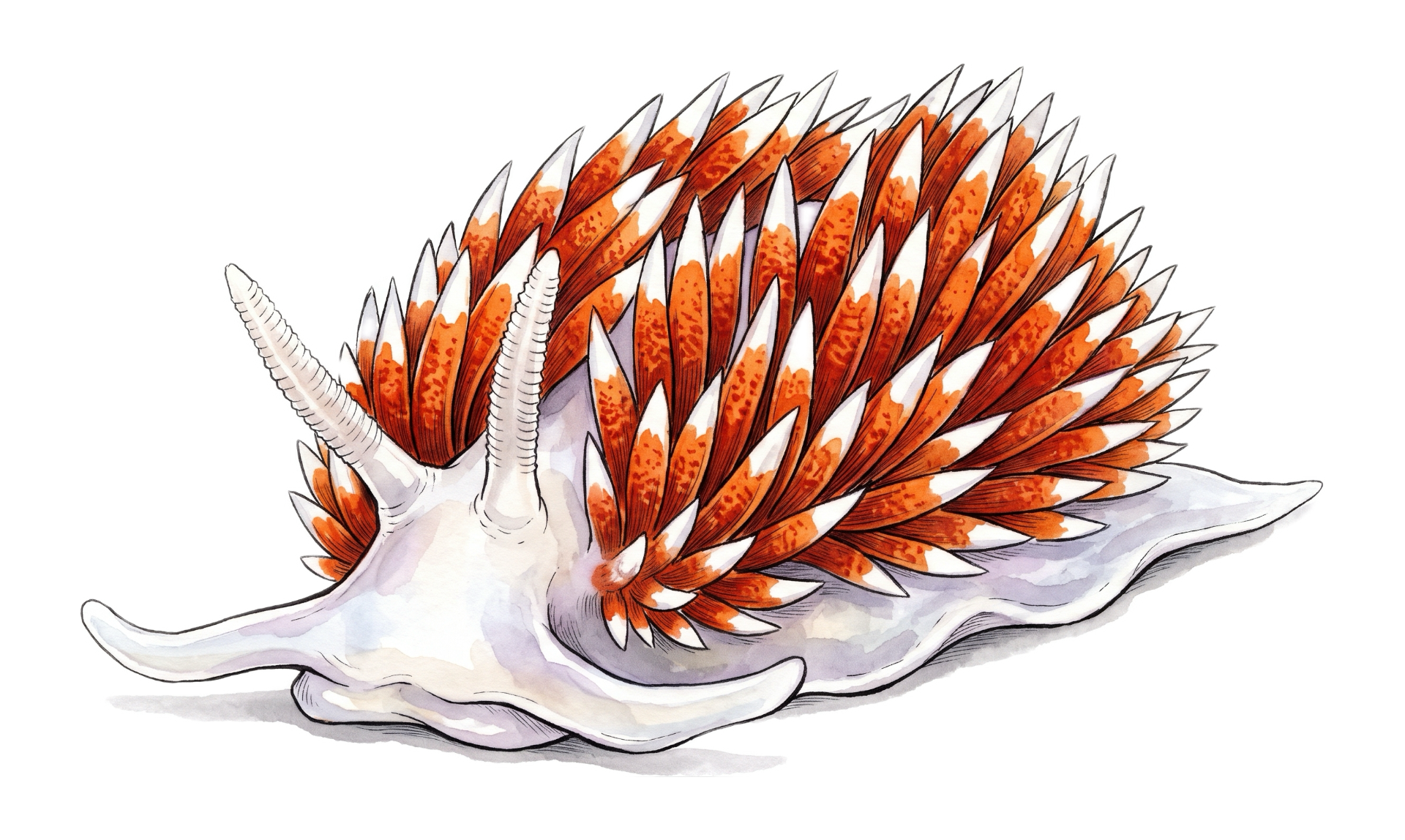
Common name: Flameback, nudibranch.
Scientific name: Phidiana lottini.
Description: A shell-less gastropod mollusk with a translucent white or slightly reddish body. Its back is covered with numerous cerata (finger-like projections) arranged in transverse rows, each with an orange to purplish band and a white tip. A white line runs down the middle of the back, and another forms a V on the head. Its rhinophores (sensory tentacles) are ringed, and its oral tentacles are very long.
Size: It can grow up to 8 cm (3.1 in) long.
Where does it live?: It ranges from Callao, Peru, to Chiloé, Chile.
Favorite spots: It lives on rocks and seaweeds in the lower intertidal and subtidal zones, down to 15 meters (50 ft) deep, in places where hydroids grow.
Diet: Like other aeolid nudibranchs, it feeds mainly on hydroids, small colonial animals related to jellyfish.
Fun facts: Its cerata have several functions: they help it breathe, and its digestive system branches inside them, showing as a dark band through the wall. It was described in 1831 by French naturalist René Primevère Lesson from specimens collected in Talcahuano during the expedition of the corvette La Coquille. For a long time it was known as Phidiana inca, until in 1997 researcher Michael Schrödl determined that both names referred to the same species and that the older one was valid.
References: - Zagal, C., & Hermosilla, C. (2001). Guía de invertebrados marinos del litoral valdiviano [Guide to Marine Invertebrates of Valdivia].
- Schrödl, M. (1997). Range extensions of Magellanic nudibranchs (Opisthobranchia) into the Peruvian faunal province. The Veliger, 40(1): 38-42.
Conservation status: This species has not been assessed by the International Union for Conservation of Nature (IUCN), and it has not been included in the Species Classification Regulation (RCE) of Chile’s Ministry of the Environment.
Extinct
Extinct in the wild
Critically endangered
In danger
VULNERABLE
NEAR THREATENED
LEAST CONCERN
DATA DEFICIENT
NOT EVALUATED
Extinct
Extinct in the wild
Critically endangered
In danger
VULNERABLE
NEAR THREATENED
LEAST CONCERN
DATA DEFICIENT
NOT EVALUATED