Amid the endless sound of the waves, a thick, gray coastal fog rolls inland. At times visibility is low, and the mist seems to slowly cleanse and purify everything it touches on this cold autumn morning. Through the dense clouds, quick, elusive swallows flutter about, appearing out of nowhere, while brief patches of light reveal rocky outcrops where herons, black-crowned night herons and cormorants rest.
There is so much excitement about what the day holds that not even the cold can dampen the mood or the sense of wonder. After a few introductory words from the facilitators of the activity organized by Capital Azul Foundation, each participant began sharing what they love most about the sea. Stories and memories of swimming, shellfish gathering and diving came to the surface. With special sensitivity, Eloísa Garrido, from Acuario Ambulante, guided a learning experience that flowed in many directions, full of questions, answers and shared curiosity.

For a workshop on good practices in preparing and using aquariums for environmental education in TURF-Reserves, the aquarium couldn’t come ready-made: it had to be built from scratch. Pebbles, water, marine species carefully brought by Eloísa from a laboratory… together, everyone gave shape to the space. In this way, they learned not only how to set up a touch tank, but also how to care for it and take it down respectfully. The questions kept coming: about techniques, timing, species and care. Eloísa answered generously and clearly, and the fishers, both men and women, also shared their knowledge in this exchange of mutual learning.
The goal was to combine academic knowledge from marine biology with traditional local knowledge, drawing on the perspectives of representatives of the Cachagua and La Polcura Artisanal Fishers Unions. It was a collective reflection on ethics and the care of marine life in designing educational activities for children and other audiences.
“A very friendly atmosphere developed, with listening on both sides. I shared my knowledge from marine biology and, on the other side, there was the incredible knowledge of this community of fishers, both men and women. I think we made a good team, talking about the sea and its species,” said Eloísa Garrido.

The shared feeling was of having understood not only the “how” but also the “why” of each step. And to complement the information shared, Acuario Ambulante gave each participant a protocol on handling live organisms in aquariums.
Javiera Espinoza Jara, head of the education program at Capital Azul Foundation, highlighted that “it was an opportunity for different unions to share how they can spread the care of TURF-Reserves through environmental education activities.”

SHARING KNOWLEDGE
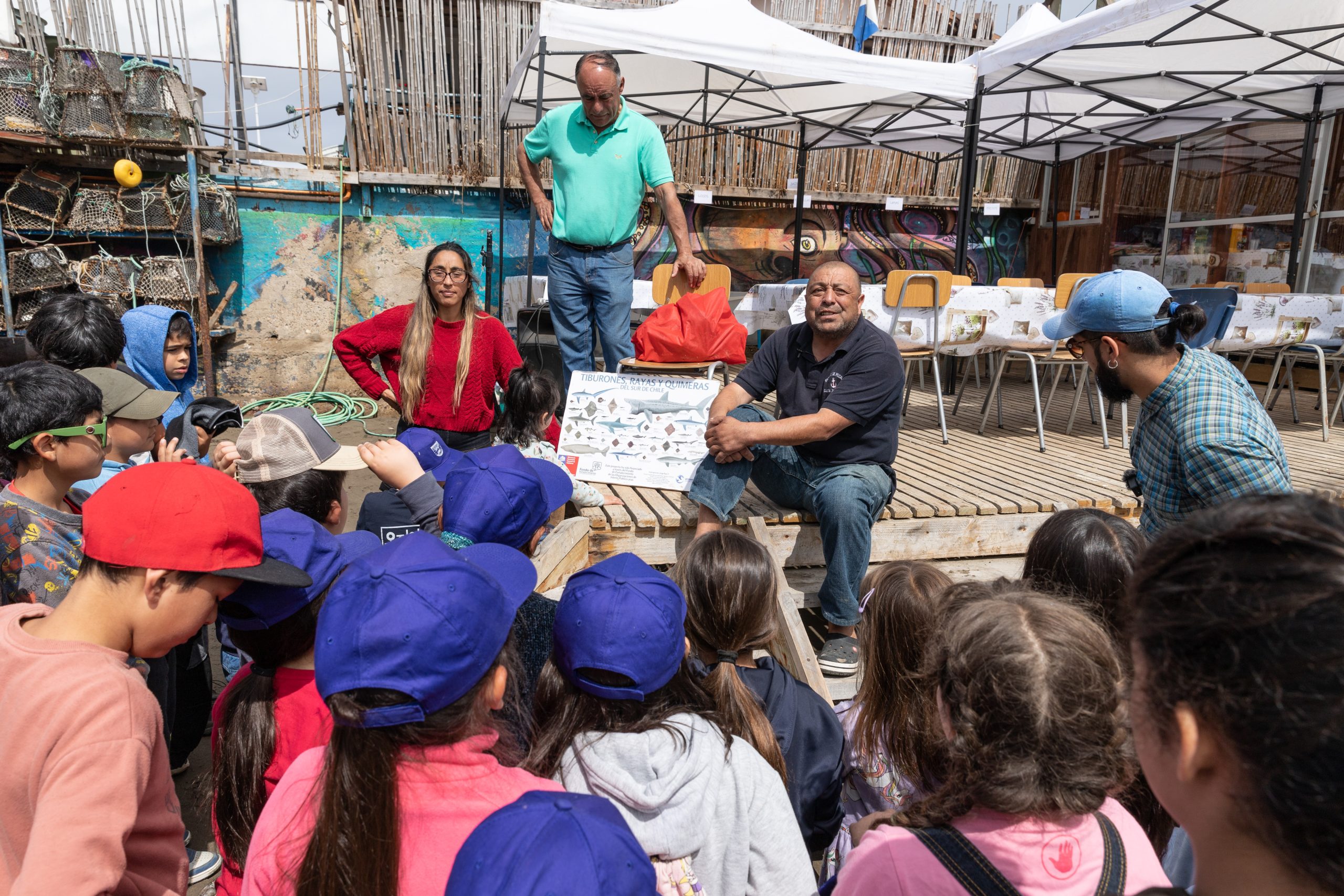
On the beach at La Polcura, in front of a dozen children from the Pichicuy School, Walter Torres showed off his teaching skills in December 2024. With charisma and captivating confidence, he shared the knowledge of a lifetime by the sea at the aquariums that he and the union set up for the inauguration of the La Polcura TURF-Reserve.
Today, with more and new tools, Walter hopes to keep planting seeds of care for the TURF-Reserve and the ocean among children. “This will help us bring in children from a school and teach them about all the species in the sea. It was a lovely experience, and I hope we keep doing it to teach other people,” said Walter.
Silvia Otárola, another member of the La Polcura Artisanal Fishers Union, said of the workshop that “the most valuable thing was really learning how to set up an aquarium: seeing what elements it needs, and that with it you can learn more about the lives of the species. It was a very good experience.”

From the Cachagua Artisanal Fishers Union, whose TURF-Reserve inauguration in April 2024 also gave children a leading role, Cristóbal Molina said that “this isn’t difficult, we can do it ourselves. Creating an aquarium at our union will help bring people closer, maybe invite a school, and show the species without harming them so people can learn about marine life. For me it’s interesting, and I think for a child it will be even more so, because it’s a way to teach them about the species in our TURF-Reserve and their conservation, which is the main thing.”
Between questions, lessons and the collective assembly of a small aquarium, this workshop left the certainty that traditional knowledge and science can talk to each other, complement each other and strengthen each other in building educational tools from within the communities themselves.
“The importance of bringing together conservation, education and community is that there are other ways of sharing knowledge about the animals and other species we find in TURF-Reserves. There is knowledge that comes from the communities and speaks of memories and identities that are important to share. That will give value to these places and allow these species to be cared for,” added Javiera Espinoza Jara.
The seeds have been planted in La Polcura and Cachagua. Now it will be local hands that keep touching the sea with care, sharing their knowledge and telling new generations stories that smell of salt and sea breeze.


RELATED NEWS