Dozens, perhaps hundreds of people move back and forth. Some seem to walk with purpose, while others wander aimlessly, as if guided by simple intuition. It is a real hive of activity, somewhat chaotic, and from a distance it can feel overwhelming, but the space is so large that it is still far from crowded.
Amid the collective murmur, scattered words in English, Spanish and other languages can be heard, reflecting the diversity of origins: delegations from around 150 countries have come here, to the Palais des Expositions in Nice, France, for the One Ocean Science Congress. The congress seeks to ensure that science-based decisions facilitate and promote the conservation and sustainable use of the ocean, just ahead of the Third United Nations Ocean Conference (UNOC3).
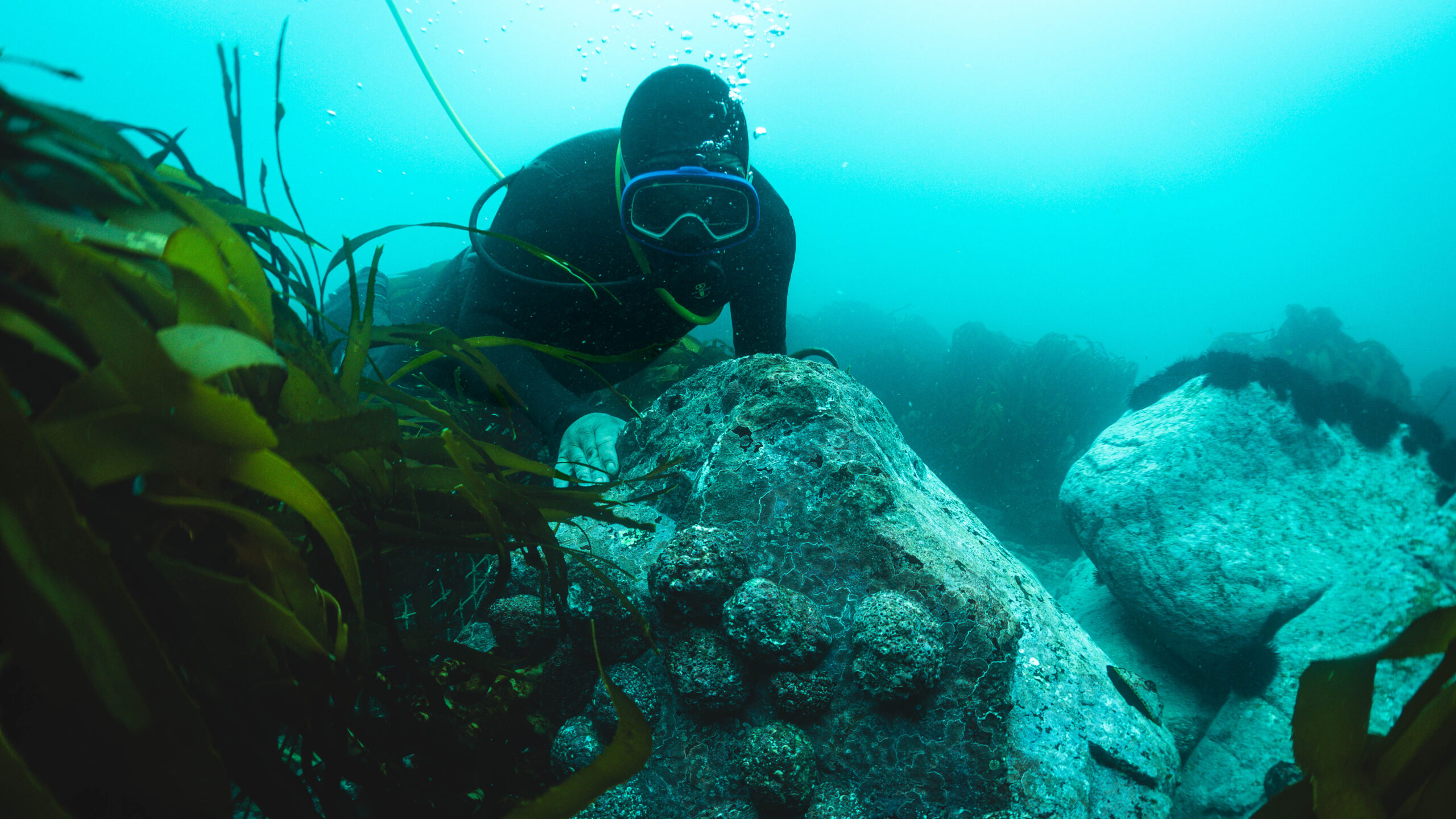
The dim light of the venue is broken only by the spotlights on the 660 scientific posters and their authors, who are there to explain their studies and exchange knowledge with their peers. Among the hundreds of posters, number 192 is hard to find, but there, in the middle of the dense scientific tide, Francisco Contreras Drey, Director of Science & Monitoring at Capital Azul Foundation and researcher at the Millennium Institute in Coastal Socio-Ecology (SECOS), presents his work: “Escape behavior of rocky-reef fish reveals the impact of spearfishing across different management regimes”.

The ocean has many voices. Some echo in the fishing coves, others can be heard in the waves. And a few, only rarely, manage to travel all the way to the big stages, very close to where decisions are made that could shape, for better or worse, the future of our relationship with the sea. From Chile, one of those voices arrived here with a question as simple as it is powerful: what does a reef fish tell us when it flees from a diver?
It is a question that opens the door to understanding how fishing, conservation and care for our sea are deeply intertwined. To try to answer it, the study used flight initiation distance, the minimum distance at which an organism begins to flee from an approaching threat. It works like a “fear thermometer” that can give clues about how heavily a given species has been hunted.
The research focused on three reef fish species that are important for spearfishing and have both commercial and recreational value: the bilagay (Cheilodactylus variegatus), the Chilean sandperch (Pinguipes chilensis) and the jerguilla, or marblefish (Aplodactylus punctatus). The study was carried out in northern and central Chile, regions with different levels of fishing pressure depending on the species, and covered three access regimes: open-access areas (unregulated), TURFs (Territorial User Rights for Fisheries, known in Chile by the Spanish acronym AMERB, with regulated artisanal fishing) and Marine Protected Areas (no extraction or fishing; in this case, the Las Cruces Marine Reserve).

The study’s key findings showed that larger fish are more cautious and have a longer flight distance, while in areas with more fishing pressure, fish were warier. In contrast, in Marine Protected Areas (MPAs) and TURFs, fish were calmer and more trusting, which suggests that protection leads fish to lower their guard and that conservation works. The study also concluded that a longer flight distance is directly associated with the threat posed by spearfishing.
IN A SEA OF POSTERS
The scientific posters could be viewed from 6 to 8 p.m. over three days. Taking some liberties, Francisco Contreras Drey did not stay by his poster the whole time, but also took the chance to walk around and learn about other studies. Two QR codes, one linking to his published article and another with his contact details, allowed him, also a researcher at the Center of Applied Ecology and Sustainability (CAPES), to move around more freely. They also sparked new technical conversations about the methods and metrics used, about the surprise of seeing this kind of work outside terrestrial systems, and questions about fish behavior and access regimes (TURF, open access and marine protected area).
“I also talked about the next steps for the study. Our idea now is to do it under the TURF-Reserve model. We haven’t collected that data yet, but the idea is to continue this work under this access regime,” explained Francisco, adding that the goal would be to compare the results with the published paper. “Ideally, we would expect to find the same behavior in the TURF-Reserves and in the ECIM reserve, and similar differences compared with TURFs and open-access areas.”
Similarly, if this study were replicated in a TURF-Reserve set up only a couple of years ago, the expectation is to find differences compared with TURF-Reserves that are more than five years old. This could be another line of comparison: analyzing the differences between TURF-Reserves according to how long they have been in place.

EXCHANGE AMONG PEERS
Beyond presenting his work, the congress was also an opportunity to explore, learn and meet other researchers and their own questions.
A PhD candidate in Ecology at the Pontifical Catholic University of Chile (PUC), Francisco Contreras Drey highlights that so many people, of different nationalities and from different corners of the planet, are trying to tackle local challenges that repeat themselves on a global scale, with a view to ocean sustainability and the resilience of coastal communities.
Unlike the scientific posters, which dealt with specific, more niche topics, the broader themes were addressed through speakers and oral presentations. In one of those sessions, Stefan Gelcich Crossley, co-founder of Capital Azul Foundation and a PUC professor, presented his work “Co-producing improvements in the effectiveness of enforcement agencies to combat illegal fishing,” a talk that Francisco Contreras Drey also attended.
“I feel we’re all working on similar things. For example, with illegal fishing, you can see that the problems repeat themselves in other types of areas, in other countries. So the good thing is that cross-cutting problems were addressed, not so much niche ones,” said Contreras Drey, adding that “many of the challenges related to TURF-Reserves could, in one way or another, be seen there with top speakers, so it was a chance to refresh and learn new things.”
Like other scientific congresses, the One Ocean Science Congress also served as a platform to build networks and encourage collaboration among peers. “It was a great experience to be able to share with people in science, and to see that there are people working in the same direction in terms of conservation and sustainability. And also to see that what you’re doing can be replicated by others. That’s what’s rewarding,” said Francisco, emphasizing the importance of sharing lessons, being open to new ways of doing research and continuing to build networks that connect science with the communities that depend on the sea.
RELATED NEWS