In late May, Capital Azul Foundation took part in the Marine Science Congress, the 43rd edition of an event that brings together specialists from many ocean-related fields. This year’s gathering, held in Concepción, covered topics such as fisheries, resource management, oceanography, aquaculture, marine ecology, and marine science outreach and education, among others.
Capital Azul’s participation aimed to share with the academic community and other attendees the lessons learned and challenges of the Communities & Education area in working with artisanal fishers to protect the TURF-Reserves established within Territorial Use Rights for Fisheries (TURFs).
“The participation of different stakeholders is important for marine conservation; this has been endorsed by many authors and by international agreements signed by Chile. But little is said about how this is put into practice and what effective participation means, and that is when the challenges start to appear,” explains Paulina Martínez Marín, director of Capital Azul’s Communities & Education area.
Paulina was one of the members of the Capital Azul team who attended the event in Concepción, where she took part in a Conservation and Socio-ecology panel with a presentation titled “Strengthening collaboration for the care of marine and coastal ecosystems: Boosting the TURF-Reserve Network with fishers unions, scientists, local authorities and coastal communities in the Valparaíso Region, Chile.”
There she presented the network-based work carried out with a wide range of stakeholders, with an approach centered on fishers’ organizations that promotes their empowerment and leadership so they can become an active node and be in a position to interact with other stakeholders across different levels of power and interests.


The participation of different stakeholders is important for marine conservation; this has been endorsed by many authors and by international agreements signed by Chile. But little is said about how this is put into practice and what effective participation means, and that is when the challenges start to appear.
Paulina Martínez Marín
Director of Communities and Education
Capital Azul Foundation
Rodrigo Barría, representing the TURF-Reserve Committee of the Maitencillo Artisanal Fishers Union, also attended the Marine Science Congress. Together with Javiera Espinoza Jara, head of Capital Azul’s Environmental Education program, Rodrigo gave a talk titled “Less blah blah and more glug glug: artisanal fishers toward environmental education in TURF-Reserves,” as part of the 8th Symposium on Marine Science Outreach.
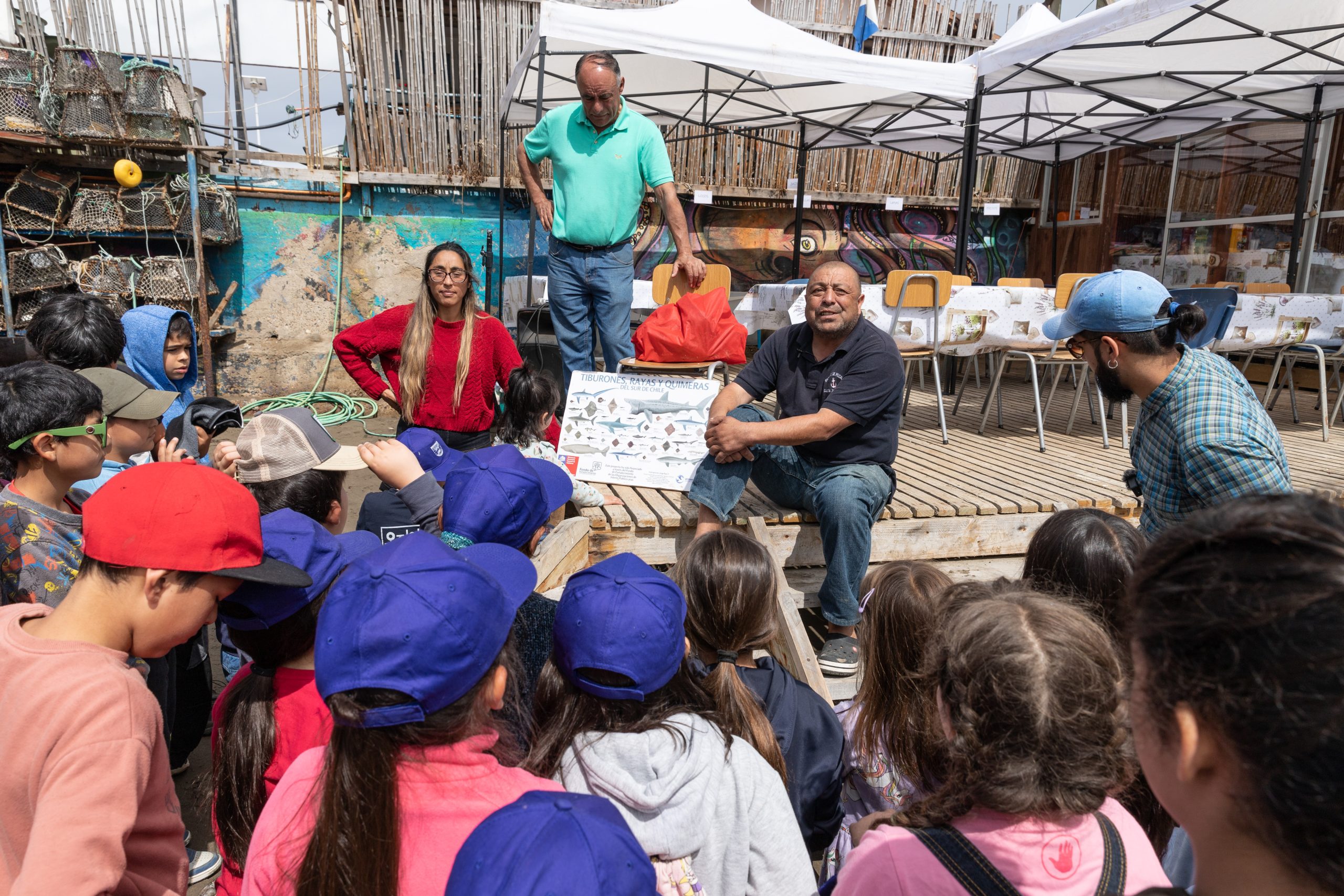
The talk presented the work behind the intertidal trail co-created by the Maitencillo Artisanal Fishers Union and the Capital Azul team, which was inaugurated during the first anniversary of the Maitencillo TURF-Reserve in November 2023 with the participation of students from Escuela Maitencillo.
“First of all, I would like to thank Capital Azul Foundation for the invitation. As an artisanal fisher, it’s impossible to set aside resources to attend these science congresses,” Rodrigo acknowledged.
“There’s no doubt we need to be up to date and informed about academic progress, and I mean in every field: marine sciences, social sciences, law, food, the environment, education… So many topics are linked to our activity that I think we should be more present at these kinds of gatherings, and the organizers (of the event) should consider setting aside places for representatives of artisanal fishing. That way we could start answering the classic question some academics and scientists ask: How do we approach working with artisanal fishers?” said the Maitencillo fisher, adding that “I feel it isn’t easy for members of artisanal fishing to take part in these events, so it’s even less likely that the scientific world and artisanal fishing will come together.”
Speaking about the work with Capital Azul Foundation, especially in environmental education around the Maitencillo TURF-Reserve, Rodrigo Barría valued the opportunity to share details of the experience. “Considering it’s a project that has been running for years, I think it’s one of the best ways we can bring what we do closer to the community, especially to children from nearby schools, who will in a way be responsible for carrying on the knowledge and care of coastal areas and resources,” he added.
The talk also covered the Capital Azul team’s experience strengthening the visits that schools and other stakeholders make to the Zapallar fishing cove and its TURF-Reserve, activities led by the Zapallar Artisanal Fishers Union itself.
From Javiera Espinoza Jara’s perspective, what makes the Symposium meaningful is that it creates spaces where all forms of knowledge are valid, so that the public can learn from a diversity of perspectives and viewpoints.
“The knowledge of coastal communities and of fishers is usually not very recognized in these academic settings, and it’s extremely important knowledge for building or producing knowledge,” explains the head of Capital Azul Foundation’s Environmental Education program, highlighting the importance of opening spaces for artisanal fishers at events like this.
“In these settings there is still a view, which people are trying to change, that knowledge has to be passed down, but there is no cross-cutting or comprehensive view when it comes to creating knowledge; the question is almost always how we pass information down to the community. It’s an unfair view that doesn’t validate all forms of knowledge. So it’s extremely important that fishing communities can take part in spaces like the Symposium or the Marine Science Congress, to start bridging those gaps and also so that this participation fosters new leadership,” Javiera concludes.
I feel it isn’t easy for members of artisanal fishing to take part in these events, so it’s even less likely that the scientific world and artisanal fishing will come together.
Rodrigo Barría
Member of the TURF-Reserve Committee
Maitencillo Artisanal Fishers Union
RELATED NEWS